|
Published
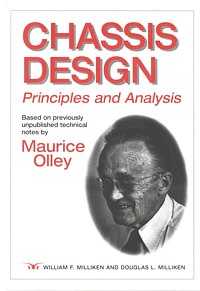
in February 2002, this 700 page book is based on previously unpublished
technical notes by vehicle dynamics pioneer Maurice Olley.
Upon
retirement, in the early 1960's Olley wrote a series of monographs totalling over 500 pages. These monographs set forth
the foundations of vehicle dynamics as experienced by Olley himself. His
mathematics and explanations on oversteer/understeer, steering, ride,
suspension design, oscillations of the unsprung masses, overall vehicle
dynamics and many other topics are as valid today as when they were first
written.
To read the text of the back cover, click here.
To see the Errata List, click here.
Bill and
Doug Milliken have rearranged Olley's monographs into a single book.
Olley's original figures have been retouched and retained. The mathematics
has been updated to match today's accepted symbols. Explanatory comments
and derivations have been added where it was thought to be helpful.
Additional material is contained in the appendices and the book begins with
Olley's Reminiscences--the closest Maurice Olley came to writing an
autobiography.
We invite
readers to send their comments and suggested corrections to us at info@millikenresearch.com.
Visit the SAE
Bookstore for purchasing information.
Click here for a book review by the Rolls-Royce
Owners' Club
Click here for a book review by the Vauxhall
Owners' Club 1903 to 1957
At the SAE
Automotive Dynamics and Stability Conference in Troy, Michigan, May 15,
2000, Bill Milliken told some stories about Maurice Olley. Our good friend (and contributor to
"Chassis Design"), Tom Bundorf, has created this illustrated version of
the talk from the video, using Bill's original lecture notes, scans
from the video and from various Olley publications.
At the
same SAE Automotive Dynamics and Stability Conference, Tom Bundorf
presented an overview of vehicle dynamics
developments at General Motors during the period 1952-1980. Following the pioneering work of
Olley and his associates, a new generation of engineers put this technology
to use. Tom has created an
illustrated version of his talk and kindly given us permission to post it
here.
|